
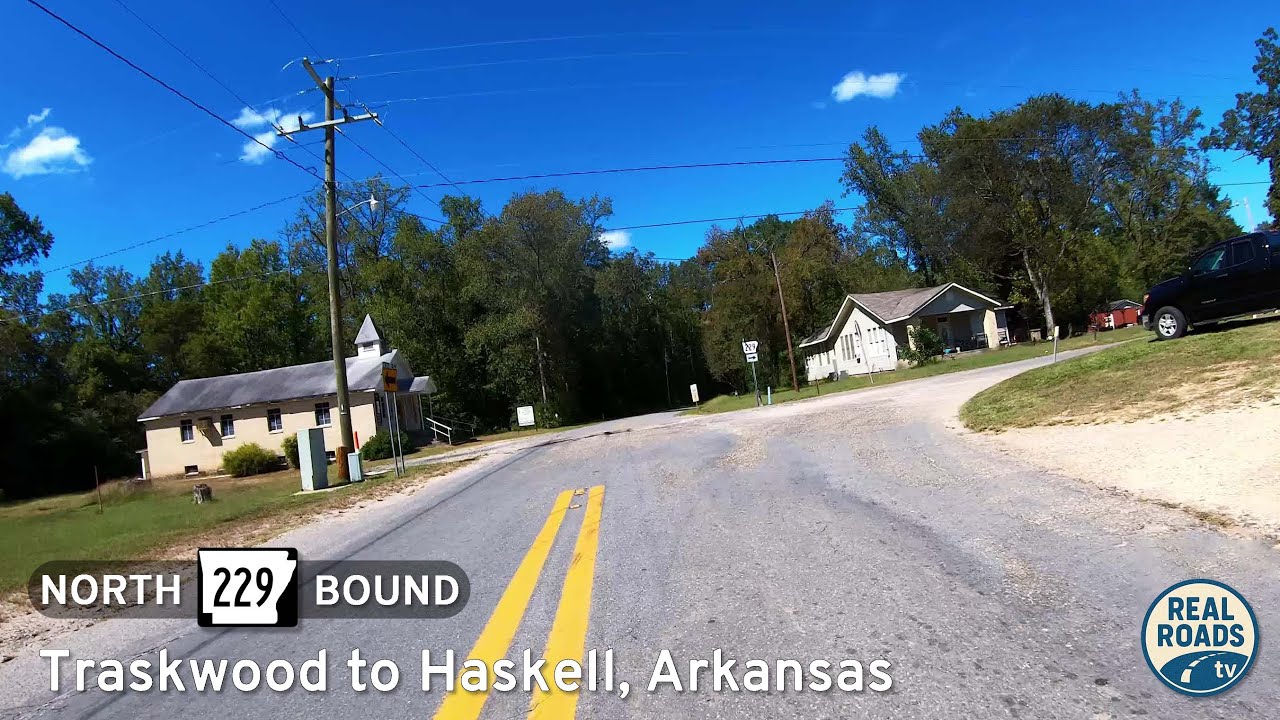
Take a smooth ride across the edge of Saline County’s pine country as we follow Arkansas Highway 229 from Traskwood to Haskell, watching a quiet two-lane grow into a well-signed approach to the I-30 corridor. This eight-mile run trades rural rhythm for small-town bustle in the span of a coffee break, the kind of transition that shows how a short connector can carry a lot of local life.
We roll out from Main Street in Traskwood, where 229 doubles as the town’s front porch. Mailboxes and side streets slip by as we ease north, the pavement settling into that familiar Arkansas two-lane profile—double-yellow centerline, narrow shoulders, and enough sweep in the curves to keep the cadence unhurried. Stands of planted pine crowd the right-of-way, then break to reveal small pastures and homes set back behind ditchlines. Here the land is gently folded; shallow creeks and low ridges nudge the sightlines, and you catch glimpses of utility cuts where the trees step aside and the sky opens for a moment. Traffic is local and practical—work pickups, school runs, the occasional log truck—so our speed feels dictated by the day’s chores more than by a timetable. Every couple of minutes, a county road appears with a name that means more to people who live here than to a GPS: farm lanes, timber tracts, and family places stitching Traskwood into the countryside around it.
North of town the forest closes in again, and we find the “edge of the pines” personality that defines this stretch. The highway rides shallow benches above wet draws, then tips through gentle s-curves where the pines lean in, their trunks forming a tidy picket as we pass. Between these green corridors, pasture gates and hay rings speak to long-worked ground—cattle close to the tree line in summer shade, fresh-cut round bales stacked just off the fencerow. The road surface is generally tidy, with a few patched seams that tell their own story about winter freezes and spring thaws. This is not a scenic byway in the glossy-brochure sense, but it is scenic in the everyday way: a landscape doing its ordinary work while we move through it.
As Saline County tilts us toward Haskell, subtle cues announce the approach to a busier world. Shoulder widths breathe out; passing zones become rarer; turn pockets start to appear at busier crossroads. We begin to meet commuter traffic—sedans and crossovers angling toward Benton or Little Rock—folding into the flow with school buses and work vans that still carry the DNA of 229’s rural purpose. Advance guide signs sharpen the message: we’re setting up for U.S. Route 67 and the tie-in to Interstate 30. The landscape mirrors the change. Tree lines thin, frontage parcels get shallower, and land use shifts from woodlots and pasture to service yards, small shops, and new rooftops edging outward from Haskell’s core.
The junction with US-67 does exactly what it was built to do: it gathers the local energy of 229 and funnels it toward the interstate. We slip into a brief concurrency with 67, and the character of the drive flips from rural cadence to corridor logic—clear lane markings, a few signalized movements, and a modest uptick in pace as we join travelers who’ve been running in from Malvern, Arkadelphia, and points south. Shield assemblies stack up—US-67, I-30—to remove any doubt about where we’re headed. If you’re watching the details, this is where design shifts are easiest to spot: deceleration lanes lengthen, turn bays are better protected, and sightlines stretch to meet standards for higher volumes. It’s a small thing, but it tells a big story about how these roads knit the county together.
The final approach carries us through Haskell’s sphere—neighborhood streets and daily-errand driveways mixing with through movements—and then the interchange area comes into full view. Ramps peel off toward I-30, frontage movements cluster, and the guide signage makes a neat handoff from local wayfinding to regional direction. Our concurrency with US-67 has done its job; AR-229’s local stream has merged with a wider river. There’s no drama about it, just a smooth, legible glide into the interstate environment where the east-west backbone of central Arkansas moves people and freight between Little Rock, Texarkana, and beyond.
What lingers after we’ve reached the interchange is how compact this evolution feels. In just a few minutes we’ve traveled from planted pines and pasture gates to turn pockets and ramp gore points, from the errands of Traskwood to the commute of Haskell. Along the way, AR-229 shows why these connectors matter: they keep communities stitched together at a human scale while still offering a clean on-ramp to the larger network. We come away with the sense that this highway doesn’t try to be more than it is—steady, useful, and rooted—and that’s exactly why it works.
🎵 Music: Track List
Music from this video may be available for purchase at https://theopenroadcollective.com
🗺️ Route Map

0 Comments